
Friday, 4 March 2016

Apple is selling more phones in India’s biggest cities than you might think


Conventional wisdom dictates that Apple and its expensive devices perform best in Western markets, where operator-subsidized contracts are commonplace and consumer spending power is greater. China aside, Asia has been a tough nut for Apple to crack, but it turns out the U.S. company is doing a lot better in India than many may have expected.
Apple accounted for less than one percent of smartphone sales nationwide in Q3 2015, but a new report from IDC found it racked up 4.6 percent of sales in India’s top 30 cities — which the analyst firm estimates account for 51 percent of country-wide sales — during the last quarter of business.
In fact, Apple’s share of sales is higher still at 5.8 percent if you look only at India’s tier-one cities. In addition, IDC claimed, the launch of the iPhone 6S and iPhone 6S Plus last year saw Apple retain the crown as the top seller in the $300-plus segment, hauling in 42.1 percent of the market despite the price of the devices in India initially being the highest in the world.
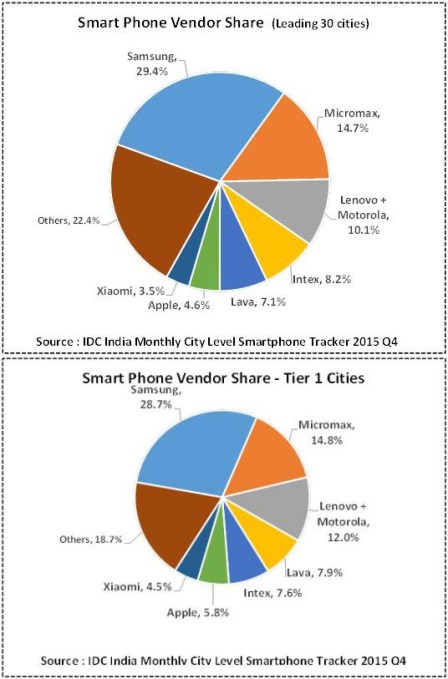
idc figs2
This is the first time that IDC has published figures that drill down to city-level in India, so it isn’t possible to analyze  growth based on previous quarters. But, even standing alone, the data demonstrates that Apple’s recent decision to increase its focus on India — where itwants to sell refurbished older devices to stretch its pricing range, is working to open its own retail outlets, and has slashed prices — is coming for good reason.
With 220 million smartphone users, India is now a larger market for phone makers than the U.S.. But there are a couple of factors worth recalling when thinking about the opportunity for Apple and others in the high-end of the market.
Budget devices dominate when it comes to volume. IDC estimates that two-thirds of the smartphones sold in India’s tier-two and tier-three cities — which alone account for just over 20 percent of the market — are priced below $100. That’s a bracket that Apple simply doesn’t play in, even with older phones, and that’s why it is not among the top sellers based on nationwide marketshare. But the company has always emphasized higher margins, and financial indicators — such as its first billion dollar sales year and a 76 percent annual sales increase — show it is making progress in India.
Apple aside, the IDC report found that Samsung leads the field in urban areas, with 29.4 percent of sales across India’s top 30 cities and 28.7 percent in tier-one locations. Home-grown rival Micromax followed the Korean company in both of those rankings, ahead of a glut of Android makers and Apple. Interestingly, Xiaomi, which is placing significant focus on India, sold less than Apple in urban areas, according to IDC’s numbers, although the figures don’t represent all sales across the country.

Two new apps, Daycap and VideoSlam, help you create GIFs and videos to remember your day


Two new, recently launched applications, Daycap and VideoSlam, make it easy to summarize your day in the format of videos or GIFs, which can then be shared out to social media. Do you need these apps on your iPhone? No. Are you totally going to download them on your lunch break because it’s Friday, they sound fun, and those TPS reports can wait? Yep!
Daycap
The first application, currently being featured on iTunes’ “Best New Apps” section is calledDaycap, and it turns all your photos from the day into a GIF slideshow that’s perfect for sharing on Instagram, Facebook or elsewhere.
The idea in theory is fairly solid – it’s a way to turn all those excess photos into a clever, animated summary of your day. However, its real-world use case for the time being is somewhat limited. The problem Daycap suffers from is that it requires you to take photos while in the app, instead of allowing you to also access photos from your Camera Roll.
The app would be a lot more practical if you could pull up your past photos, or if it even suggested your best photos using some sort of smart algorithm that hid those that were blurry, dark, or duplicated, for example.
Still, the app itself is both simple and fun to use.

In addition to snapping photos using its built-in camera, you can also add your location to the GIF, add a title using various font styles, and use an editing utility lets you delete photos you take in Daycap or save them to your Camera Roll.
The app was developed by the team at San Francisco-based Memry Labs, which was founded by ex-Googler Rohan Seth and ex-Microsoftie Rohan Dang, also formerly of Causes. According to LinkedInAngelList, and CrunchBase, the startup has an undisclosed amount of seed funding from Khosla Ventures, Resolute Ventures, Curious Endeavors, Marc Bell Ventures, and other angels.
VideoSlam
VideoSlam is a bit more versatile than Daycap, though that also means it has a bit more of a learning curve. As the name suggests, this app isn’t about creating GIFs, but rather videos. Similar to Daycap, VideoSlam lets you combine various photos to turn them into a fast-moving summary of a point in time.
However, VideoSlam differentiates itself by allowing you to grab both photos and videos from the past, instead of asking you to record using the app. It also nicely organizes your past footage for easy access into sections like “Last Hour,” “24 Hours,” “Today,” “Yesterday,” “Last 7 Days,” “This Month,” “Last Month,” and so on. That way, you can quickly assemble a video of your moments with little effort.

The app can also remind you to film by setting an alarm – something that would be useful if you’re doing a larger compilation of sorts.
“More and more people are using mobile video to document their lives and tell their stories and we’d like to build the ecosystem to support them,” explains co-founder Adriaan Stellingwerff who built the bootstrapped app with Mei OlĂ©. The team is split between Berlin and Sydney, he says.
“We are currently focused on developing better creative tools for mobile video with VideoSlam and Kinomatic, a pro video camera app we launched in 2014,” Stellingwerff adds. “In the longer term we aim to go beyond tools to address the other big challenges storytellers face – primarily distribution and finding (niche) audiences.”
The company may also offer VideoSlam hosting as a means of generating revenue in the future, the co-founder tells us.
VideoSlam is free, with in-app purchases ($3.99), on iTunes.

What’s interesting about both these applications is that the hint at the need for more tools that can help us look back on our lives, including our photos and videos, and do so more quickly. That speaks to a problem that hasn’t really been solved. Because smartphones have made it possible to record a nearly unlimited amount of footage, we’re overwhelmed with the output and now tend to treat photos and videos as disposable creations. We share them, then forget them.
Elsewhere, many photo and video archival services today try to re-create the concept of the photo album for a digital age – organizing everything by date and time. Other efforts, like Timehop, Facebook’s “On This Day,” or Google Photo’s “Rediscover this Day,” attempt to surprise us with a brief look back at a single day from a prior year.
These new apps, meanwhile, are attempting to re-imagine how we can explore the past. Whether they make a lasting impression themselves, of course, remains to be seen.

via techcrunch.

Tuesday, 19 January 2016

Android users will be able to install apps directly from search


When you Google for apps on their respective mobile platforms, the main results appear on top inside their own panels. That makes them easy enough to install, but Google wants to make it even easier. According toAndroid Police, Mountain View has started rolling out a feature that allows Android users to install apps directly from search results.
Simply type in a query -- for instance, "Engadget Android app" -- and tap on the top result. Instead of taking you to the Play Store, a new windows pops up. When you click Accept, the Install window replaces it still within the search results. AP says some users have had it for at least a month now, but it doesn't seem to be available to everyone yet (I can't replicate the results you see below myself). If you want to try it out, make sure to use the Google app, as it doesn't seem to be working for the Chrome browser.
Source: Engadget

HTC Denies Reports It Will Spin Its VR Business Into A Standalone Company


Virtual reality is becoming a major focus for struggling smartphone maker HTC, but not so major that it will spin out its VR business into a standalone company.
The firm today issued a statement denying a report from local media in its home country of Taiwan which claimed Chairwoman Cher Wang is in the process of creating a new VR entity that is wholly owned by her and HTC. The report suggested that the idea of a spin-out was first raised last year, around the time that then-CEO Peter Chou stepped down to lead product development, but was abandoned for some reason and is now being revived.
Not so, HTC said:
Recent media reports in Taiwan, such as by United Evening News, stating that Cher Wang is planning to spin off HTC’s VR operations into an independent entity that will be wholly owned by Wang is incorrect. HTC will continue to develop our VR business to further maximize value for shareholders.
Speaking of shareholders. HTC’s stock price jumped at the initial reports, rising by over five percent to NT$76.60. If you’ve been following HTC — which was trading below its cash on hand last year, effectively making the company worthless — then you’ll know that moving its needle in a positive direction is no easy thing.
HTC is pinned its comeback on a combination of cost-cutting (15 percent layoffs) and more marketable devices, but the company said that the Internet of things, wearables and VR are also areas where it believes it can rebuild its popularity with consumers.
The company forged important links last year as Chou took a role as executive director role with Hong Kong-based Digital Domain, in addition to his work with HTC and HTC invested $10 million in VR platform company WEVR.
The initial fruit of the company’s VR labor is the HTC Vive which, following much delaywill finally be available in AprilThe device impressed us last year, but how will it fare among the general public? We’ll see soon.

Source: Techcrunch

Uber Makes First Big Expansion In China As It Aims To Reach 100 Cities In 2016


Fresh from raising new funding, Uber China — Uber’s dedicated business in the world’s largest country — is embarking on its largest expansion to date which will increase its coverage to 37 cities, up from 22.
Uber China has slowly expanded its coverage of China with launches in large cities thus far. In a change of approach, it said today that it will launch in 15 new cities in Sichuan, China’s fourth most populous province, before Chinese New Year on February 8.
Sichuan, a 485,000 km square region with a cumulative population of over 80 million people, is already a hotspot for the company. Provincial capital Chengdu is Uber’s top city worldwide, based on weekly completed trips, and it reached the number one spot just nine months after Uber launched there. And there’s apparently promise of more: Uber said its volume in second city Mianyang, where it launched in November, is forty-times higher than Chengdu was at that stage of launch. (Uber didn’t give raw figures for either city, though.)
Now, it is zoning in on the region and expanding its coverage into tier-two and tier-three cities in Sichuan. Uber told TechCrunch it already ‘soft-launched’ in five cities, but it is targeting an additional ten in order to fully cover the main cities in Sichuan ahead of Chinese New Year, which is the largest annual migration on the planet as urban-based Chinese return en masse to their hometowns for the holidays.
More broadly though, this expansion is a sign of things to come for Uber in China this year.
The company declined to disclose specific expansion plans for the year when we asked — citing the need to keep information confidential and away from competitors — but last year it revealed it would take its coverage to more than 100 cities in 2015. This move in Sichuan looks like phase one.
“2015 was Uber China’s ‘Year of Localization’ and 2016 will be our ‘Year of Growth’,” Zhen Liu, who is Uber China’s Head of Strategy, said in a statement.
“We have built a strong foundation across the country and have put in place an excellent local team that will drive our growth in the year ahead… our goal is to be in 100 cities across China by the end of the year,” Liu added.
Reaching 100 new cities inside twelve months is a huge task, but even if Uber is able to pull it off, the company will still trail local leader Didi Kuaidi on total national coverage. Didi Kuaidi, which is valued at $16.5 billion versus Uber China’s $8 billion tag, is present in over 360 cities and towns — and is reportedly at break-even in more than 100 of them.
That’s not quite all from Uber China in Chengdu. The company also said it is opening up ride-stations in “well-known” landmarks across the city. The idea is to create designated areas where drivers can meet passengers — similar to ‘suggested pickup points’ it is testing in the U.S. — because it can be surprisingly hard to rendezvous, particularly if a passenger is new to, or visiting, the city and not familiar with its road system.
The stations have been added to Baidu maps, the service that is China’s top mapping app andrun by Uber investor Baidu.

Source: techcrunch